
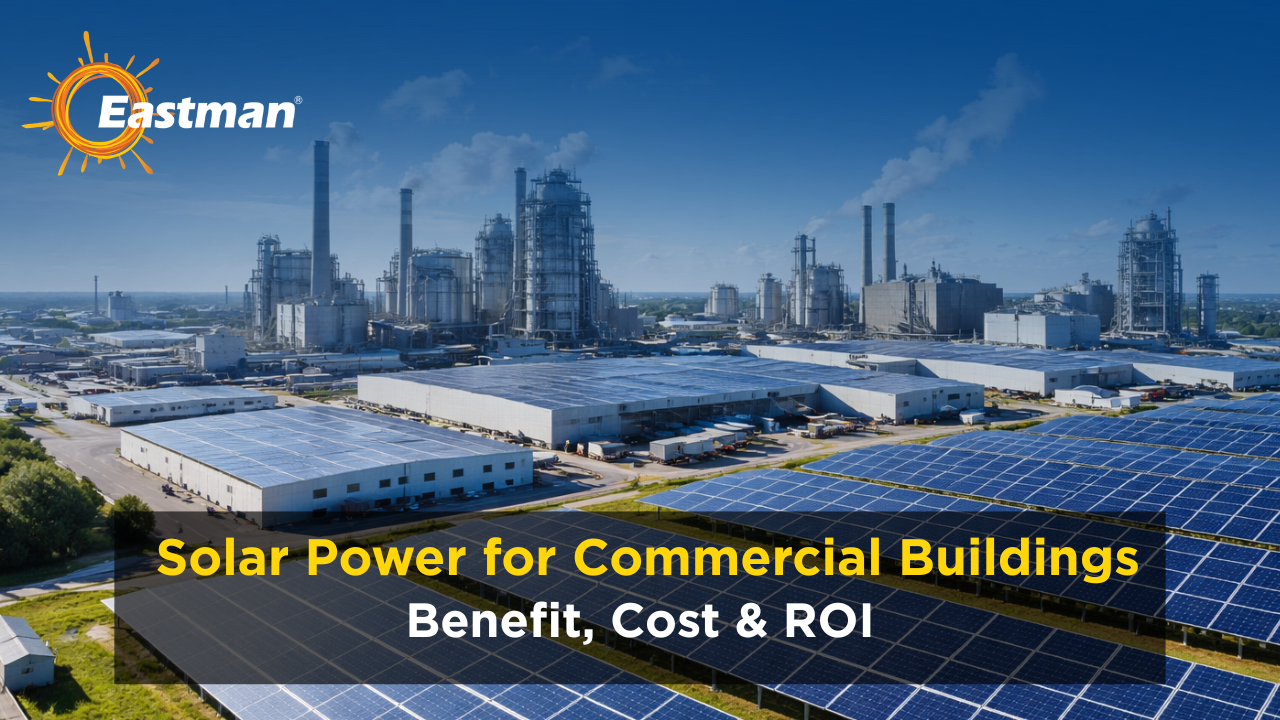

In today’s competitive business landscape, solar power for commercial buildings isn’t just an eco-friendly addition; it’s a strategic investment that reduces operational costs, enhances sustainability credentials, and improves long-term profitability.
In an economic landscape characterized by fluctuating energy markets and rising operational costs, business owners are increasingly seeking stability. As organizations look to secure their financial future and “future-proof” their operations against grid instability, solar power has emerged not just as an environmental choice, but as a strategic financial instrument.
Transitioning to commercial solar energy is no longer a speculative venture; it is a calculated investment that offers tangible returns. By leveraging underutilized roof space or land, businesses can transform a passive asset into a revenue-generating power plant.
Whether you operate an office complex, hotel, manufacturing unit, hospital, or retail space, this guide will help you understand the benefits, cost implications, ROI expectations, and financial justification for adopting solar energy.
The Commercial Solar Power and Its Benefits
Solar power for commercial buildings involves installing solar photovoltaic systems typically on rooftops or open spaces to generate electricity that directly powers business operations.
Commercial solar differs from residential installations because it caters to higher energy loads, higher tariffs, and larger system scales.
Key Benefits of Commercial Solar
1. Significant Cost Savings and Operational Efficiency
The most immediate impact of installing a solar photovoltaic system is the reduction of utility bills. Businesses can lock in electricity costs and protect themselves from rising tariffs.
2. Environmental Impact and Corporate Responsibility
Adopting solar energy reduces carbon footprint and strengthens corporate social responsibility while enhancing brand image.
3. Energy Independence and Security
Solar systems combined with battery storage ensure continuity during grid outages and protect businesses from downtime.
4. Increased Property Value
Commercial buildings with solar installations often have higher market value and better long-term asset performance.
Understanding the Cost of Solar Power
Initial Investment Breakdown
Hard costs include solar panels, inverters, mounting structures, and batteries. Soft costs include labor, design, approvals, and commissioning.
Maintenance and Operational Costs
Solar systems require minimal maintenance, mainly periodic cleaning and inspection. Inverters may need replacement once during the system’s lifespan.
Financing Options
- Solar Loans
- Power Purchase Agreements (PPAs)
- Operating Leases
Cost of Solar Power for Commercial in India
The average cost of a commercial rooftop solar system in India ranges between ₹32,000 to ₹50,000 per kW.
For example, a 100 kW system may cost between ₹32 lakh to ₹50 lakh depending on quality and configuration.
| Component | Small Commercial | Medium Commercial | Large Commercial |
|---|---|---|---|
| Solar Panels | ₹4.8 – 7.0 lakh | ₹21 – 31 lakh | ₹1.0 – 1.5 crore |
| Inverters & Power Equipment | ₹1.2 – 2.0 lakh | ₹5 – 9 lakh | ₹25 – 40 lakh |
| Mounting & Civil Work | ₹0.8 – 1.5 lakh | ₹3.5 – 6.5 lakh | ₹16 – 30 lakh |
| Installation & Commissioning | ₹0.3 – 0.5 lakh | ₹1.5 – 2.5 lakh | ₹5 – 10 lakh |
Conclusion
Solar power for commercial buildings is a high-impact investment that delivers long-term cost savings, energy security, and sustainability benefits.
Partnering with trusted brands like Eastman Auto & Power Ltd. ensures reliable systems, quality components, and maximum ROI.
Ready to Unlock Long-Term Cost Savings?
Contact EAPL today for a free commercial solar assessment and customized solution tailored to your building’s needs.
- Get your estimate on Off-Grid Solar Combos & Calculator
- Explore Eastman Solar Solutions
- Contact Eastman for more information
- Find your nearest Store Locator
FAQs
Q. Will solar panels work during a power outage?
A. Grid-tied systems shut down during outages unless paired with battery backup.
Q. How long do commercial solar panels last?
A. Panels last 25–40 years; inverters and batteries may need earlier replacement.
Q. Are there incentives for commercial solar in India?
A. Yes, subsidies, tax benefits, accelerated depreciation, and net metering are available.
Q. Can I lease a solar system?
A. Yes, PPAs and leasing options are available with low upfront costs.
Q. What maintenance is required?
A. Minimal maintenance such as cleaning and annual inspections.
Share:


related Posts



Interested in buying our products?
Fill the enquiry form or call us on:
 78728 78728