
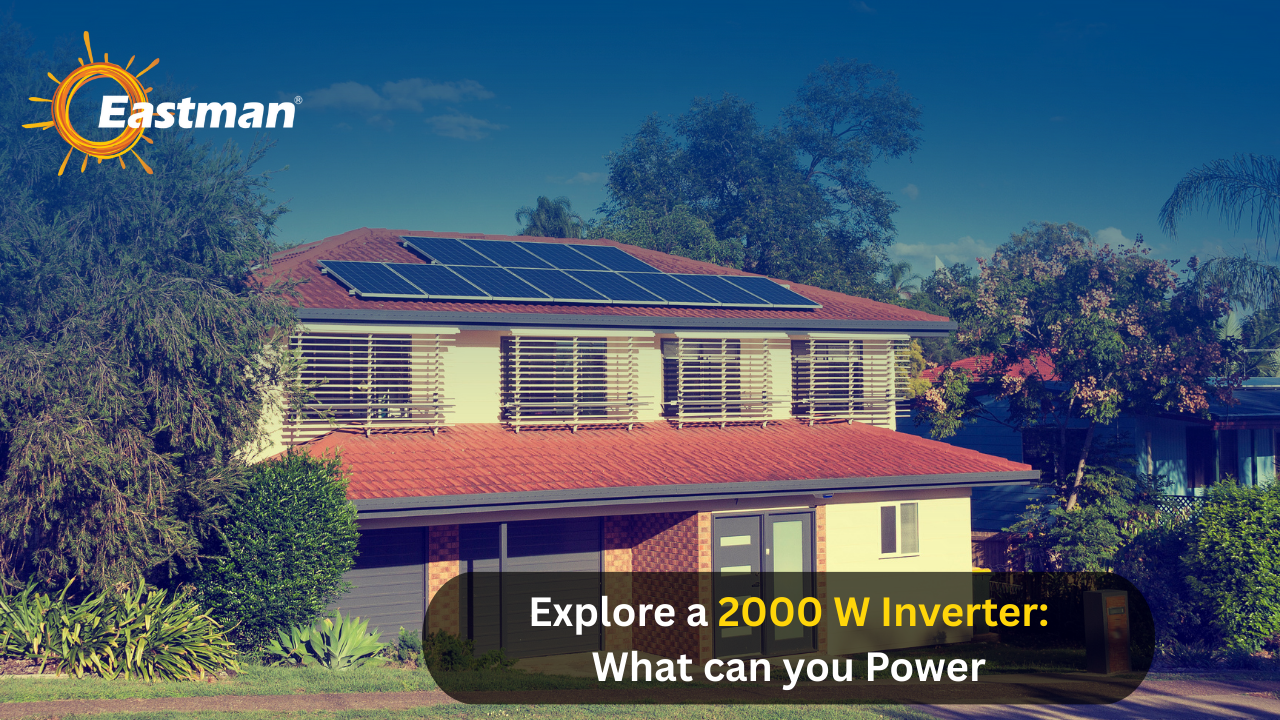

In today’s rapidly evolving power landscape, inverters have become a critical component for ensuring a reliable and efficient electricity supply. Whether used for residential backup, mobile applications, small commercial setups, or renewable energy systems, understanding inverter capacity and performance is essential for correct system planning.
One of the most common questions among users and industry professionals is: What can a 2000W inverter actually power?
This blog explains inverter fundamentals, real-world load capabilities, operational considerations, and industry best practices, using the Eastman 2000W Inverter as a reference.
What is a 2000W inverter?
An inverter converts DC (Direct Current) input power into AC (Alternating Current) output power, which is required to operate standard electrical appliances and equipment. A 2000W inverter is designed to:
- Supply up to 2000 watts of continuous AC power
- Handle temporary surge power required during appliance startup
While wattage defines the maximum load, factors such as surge handling, waveform quality, efficiency, and protection features play a crucial role in real-world performance.
Understanding Inverter Power Ratings
- Continuous Power (2000W): The maximum power the inverter can deliver consistently under normal operating conditions.
- Surge / Peak Power: Short-duration higher output required to start appliances with motors, compressors, or inductive loads.
Appliances such as refrigerators, pumps, and power tools often require significantly higher power at startups. A quality inverter is designed to support these surges without tripping or damage.
What can you power with 2000W inverter?
Below is a realistic overview of appliances that can be powered by a 2000W inverter when loads are managed correctly.
Low to Medium Power Appliances (Ideal Applications)
|
These loads can operate simultaneously without stressing the inverter.
Medium Power Appliances (With Load Planning)
|
Sequential operation is recommended to avoid overlapping surge demands.
High Power Appliances (Limited or Not Recommended)
|
Heating-based appliances typically exceed the efficient operating range of a 2000W inverter.
Best practices for using a 2000 W inverter
1. Avoid Overloading: Continuous operation beyond 2000W can reduce inverter lifespan and trigger protection mechanisms.
2. Account for Startup Surges: Always consider peak power requirements, especially for motor-driven appliances.
3. Use Pure Sine Wave Output: Pure sine wave inverters ensure:
- Safe operation of sensitive electronics
- Smooth motor performance
- Reduced electrical noise
- Higher appliance efficiency.
4. Proper Installation: Correct cabling, ventilation, and grounding are essential for safe and reliable inverter operation.
Industry applications of a 2000W inverter
A 2000W inverter is widely used across multiple sectors, including:
- Residential backup systems
- Mobile and recreational vehicles
- Small commercial setups
- Remote and off-grid installations
- Powering tools and field equipment
Its balance of capacity and efficiency makes it one of the most versatile inverter ratings in the market.
Why industry professionals choose Eastman
Eastman has established a strong position in the power electronics sector through manufacturing capability and application-focused design.
Eastman offers:
- Made in India: Products are designed and manufactured domestically, ensuring quality control and adherence to industry standards.
- Own Manufacturing Facility: In-house production enables consistent build quality, rigorous testing, and continuous product improvement.
- Scalable Configurations (20 kWh and above): Solutions are engineered to support high-capacity system requirements for residential, commercial, and industrial applications.
Rather than supplying standalone components, Eastman focuses on delivering integrated inverter-based power solutions aligned with modern energy needs.
These strengths have helped Eastman products emerge among the top solar and power solution brands globally, recognized for performance, durability, and real-world impact.
Conclusion
A 2000W inverter delivers an ideal balance of power capacity, efficiency, and flexibility when used within its designed limits. It is well suited for residential, mobile, and small commercial applications where reliable AC power is required.
The Eastman 2000W Inverter reflects modern inverter engineering, offering dependable performance, robust protection, and adaptability for real-world power needs.
Reliable power starts with the right inverter. Choose wisely. Choose Eastman.
- Contact Eastman for more information.
- Explore our inverter battery range here.
- Get to know your nearest Store Locator for convenience.
FAQ’s
Q. What is a 2000W inverter suitable for?
A. It is suitable for running essential household appliances, office electronics, refrigeration, and light machinery.
Q. Can a 2000W inverter run a refrigerator?
A. Yes, as long as the inverter supports the required startup surge.
Q. Can it power a microwave?
A. Yes, for short durations if the appliance wattage is within limits.
Q. Is a pure sine wave inverter necessary?
A. Yes, especially for sensitive electronics and motor-driven appliances.
Q. Is professional installation recommended?
A. Yes. Professional installation ensures safety, optimal performance, and compliance with electrical standards.
Share:


related Posts



Interested in buying our products?
Fill the enquiry form or call us on:
 78728 78728